Full-arch implants
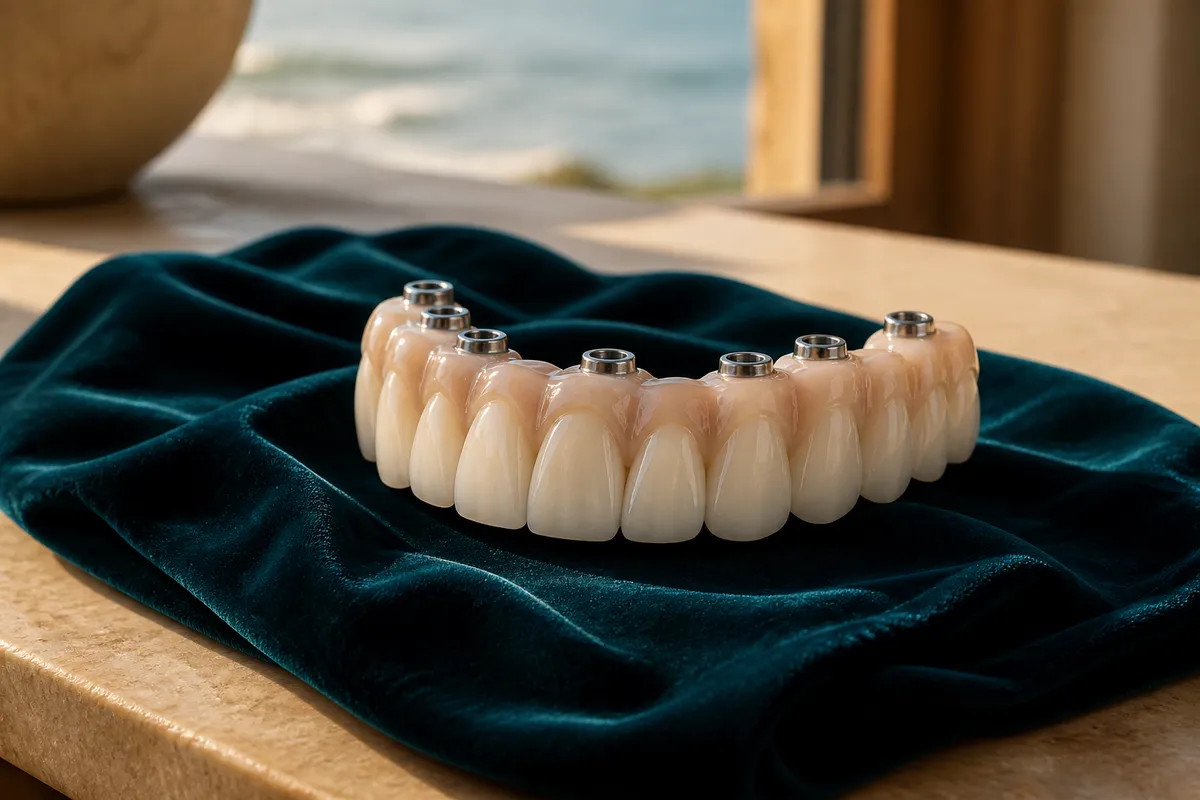
A full-arch plan replaces a failing upper or lower set of teeth with a bridge that stays in, held by four or more implants. It is not a denture you take out at night. Dr. Curtis or Dr. Samimi does the surgery. Your dentist designs the teeth.
Overview
All-on-4 is one layout: four implants hold an entire arch. The back fixtures are often tilted so they sit in denser bone and stay clear of the sinus or the nerve. Some jaws are more stable with five or six implants. The number is chosen from the scan.
Dr. Curtis or Dr. Samimi removes teeth that cannot be saved, places the implants, and coordinates with the dentist who will make the prosthesis you live with. Whether a fixed arch is realistic depends on bone, bite, and health — not on a brand.
What patients are usually hoping for
- Teeth that stay in place, without adhesive or a nightly soak
- A bite that is steadier than a loose denture
- A design that can sometimes avoid a large graft when the bone allows an angled implant
- A temporary bridge attached soon after surgery, only when the implants are stable enough
Who it's for
This is a larger project than a single dental implant. It is considered when the remaining teeth in one jaw, or both, are failing — advanced gum disease, crowns that have broken down, or a denture that no longer fits.
- You want a fixed set of teeth rather than a denture you remove
- Failing teeth need to come out, and the surgical plan has to match your dentist’s design
- Another office said you were not a candidate, and you want that opinion checked
- You already have a quote and want it compared with what these surgeons would do
A bite that is badly mismatched may need jaw surgery or a different prosthetic design. Very little upper-jaw bone may point toward zygomatic or other remote-anchorage implants, or toward grafting first. You will be told which path fits.
What to expect
The consultation is an exam plus the imaging the plan requires. Dr. Curtis or Dr. Samimi will say how many implants, whether teeth come out the same day, and whether a temporary fixed bridge is realistic. Remote anchorage needs extra planning time.
Surgery is done in the office under IV sedation, or in an operating room under general anesthesia, depending on your medical history and how much surgery the arch requires. Records and photographs are shared with the laboratory and your restorative dentist, who make the teeth after the implants are in.
Recovery
The first few days
Expect facial swelling, bruising, and a soft diet. Speech can sound odd until your tongue learns the new shape. Follow the implant aftercare page for gauze, ice on day 1 only, the rinse starting the next day, and staying off the surgical side. Swelling from a full arch is usually more than from a single implant and often peaks around day 3.
The first weeks
You will be back for short checks. A temporary tooth can chip. Hygiene under a fixed arch is a skill you have to practice every day — if the implants are not cleaned, the same gum disease can return. The final prosthesis is made by your dentist after the surgeons are satisfied with healing. There is no fixed calendar that fits every arch.
Call us if…
- Bleeding does not slow with pressure
- Swelling is worse after day 3, or breathing or swallowing is difficult
- A temporary tooth breaks, or a fixture moves when it should be still
- You are still numb the morning after surgery
- You develop a rash on an antibiotic, or you cannot keep fluids down
This is a large operation. Infection, an implant that does not hold, bite problems, and a temporary or final prosthesis that has to be remade are all discussed before you schedule. Read more in full-arch implants.
Read the aftercare instructions
Cost & insurance
What full-arch implant surgery costs depends on the plan written at your visit. Dr. Chad M. Curtis or Dr. Soroush Samimi will tell you the surgical fee after they have examined you and looked at current imaging.
The things that usually change that fee:
- Whether grafting or a membrane is part of the same surgery
- The anesthesia plan — local anesthesia, IV sedation, or general anesthesia
- The restoration your dentist builds afterward, such as a crown, a bridge, or a full arch
- Whether new imaging is needed before a plan can be written
This office takes most PPO dental plans. Call (561) 278-0004 after the consultation for an estimate of your portion. The tooth or teeth your dentist makes on top of the surgery are usually billed by that dental office.
FAQs
Is All-on-4 the same as leaving with teeth the same day?
How many implants does one arch need?
Who makes the teeth?
Will this be in the office or a hospital?
What if I was told there is not enough bone?
Can I get a second look at a quote I already have?
How do I take care of the implants afterward?
Related care
- Dental implantsA titanium fixture in the jaw that your dentist later crowns or uses to steady a bridge or denture.
- Zygomatic, pterygoid, and transnasal implantsLonger implants that reach denser bone when the upper jaw is too thin for a standard fixture.
- Bone graftingAdds bone where an implant needs more support, or where a ridge has already flattened.
- Office in Delray Beach505 SE 6th Ave. Suite C
Delray Beach, FL 33483