Dental implants
Dr. Chad M. Curtis and Dr. Soroush Samimi place the implant. Your dentist makes the crown, bridge, or denture you see. The two plans are written so the fixture comes through the gum where that tooth needs to be.
Overview
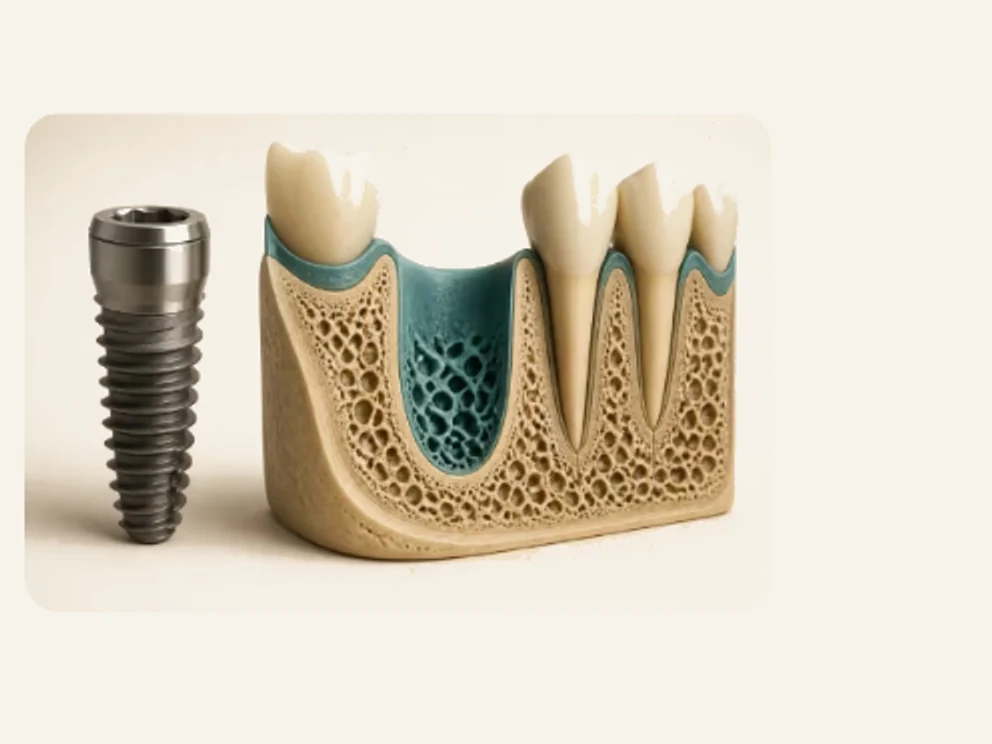
An implant is a titanium fixture set into the jaw in the space a root used to occupy. Over the following months the bone locks onto that surface. When the surgeon confirms it is steady, a connector is attached and your dentist builds the visible tooth.
How this differs from a bridge
- The teeth beside the gap are not cut down to hold a bridge
- The jaw is loaded in the spot instead of there being an empty space. This keeps the bone from experiencing atrophy.
- You brush and floss around it the way you do a tooth
- It does not shift the way a removable partial can when you chew
A bridge may still be a good option and that will be discussed at the consultation.
Chad M. Curtis, DDS earned his dental degree at Columbia, where his research was on grafting for implant sites, then trained in oral and maxillofacial surgery at the University of Cincinnati.
Soroush Samimi, DMD is a board-certified oral and maxillofacial surgeon whose practice focus is on complex implant rehabilitation.
Who it's for
This visit is for anyone who is missing a tooth, missing several teeth, or tired of a denture that moves. A restorative dentist will have to eventually make the tooth that goes on top of the implant. If you do not already have a dentist, we can help connect you with the right person.
- A tooth lost after a fracture or a root canal that could not be saved
- A gap that has narrowed because it has been empty for a long time
- A denture that lifts when you talk or eat
- A written plan from another office that you want a second look at
Active gum disease, diabetes that is not under control, heavy smoking, and a narrow ridge can change the order of treatment. Some sites need bone grafting before an implant will hold. When the upper jaw is too short, zygomatic and other remote-anchorage implants may be discussed instead of a large graft. An implant is sometimes placed the same day as an extraction. The decision to place an immediate implant or to graft and return later for implant placement is based on a variety of factors that will be reviewed at the consultation after a thorough xray and medical history review.
What to expect
The first visit is a consultation, which includes thorough examination, medical history review, record review, and treatment planning. Please bring any recent X-rays or treatment plans that you have. Once it has been determined that an implant is the best option, coordination will be completed with the dentist who will be making the implant crown.
Placement of the implant will be completed in our office. Many people choose to undergo IV sedation while others elect to stay awake and have local numbing of the mouth. Stability of the implant is checked 3 or 4 months after the implant is placed. After stability is verified, the patient will return to the dentist for fabrication of the implant crown.
Recovery
The written sheet for this surgery is the implant aftercare page. The short version:
Day of surgery
Bite on gauze for about 30 minutes. Replace it until bleeding slows; a moist tea bag held firmly for 30 minutes is the next step if it continues. Numbness can last the rest of the day because a long-acting local anesthetic is used. Ice the face 15 minutes at a time, on and off, and only on this first day. Stay on soft foods. Do not use a straw, and do not chew on the surgical side.
The next day through day 3
Start the prescribed rinse the day after surgery and use it for five days. Do not rinse hard on the day of surgery. Swelling often starts the day after and is usually largest around day 3. Soreness is commonly worst in the first 24 to 48 hours, then eases. Skip heavy lifting for two days. Light workouts can wait until after day 3. The written diet is soft food for three days, and you still should not eat on the surgical side for a week.
The first week and after
Sutures are often ready around one week. Bruising can show in the first two or three days and sometimes lingers toward two weeks. Brush gently around the site. Several implants, or an implant plus a graft, swell more than a single fixture.
Call us if…
- Bleeding does not slow after firm pressure or a moist tea bag for 30 minutes
- Feeling has not returned in the lip, chin, or tongue by the next morning
- You develop a rash after starting an antibiotic
- Swelling is worse after day 3, or you have trouble swallowing or breathing
- The implant or cover feels loose
Read the aftercare instructions
Cost & insurance
What placing a dental implant costs depends on the plan written at your visit. Dr. Chad M. Curtis or Dr. Soroush Samimi will tell you the surgical fee after they have examined you and looked at current imaging.
The things that usually change that fee:
- Whether grafting or a membrane is part of the same surgery
- The anesthesia plan — local anesthesia, IV sedation, or general anesthesia
- The restoration your dentist builds afterward, such as a crown, a bridge, or a full arch
- Whether new imaging is needed before a plan can be written
This office takes most PPO dental plans. Call (561) 278-0004 after the consultation for an estimate of your portion. The tooth or teeth your dentist makes on top of the surgery are usually billed by that dental office.
FAQs
Who places the implant, and who makes the tooth?
How long until the crown is made?
Can the implant go in the day the tooth comes out?
Do I need a bone graft first?
Will I be asleep?
Do I need a referral?
Can I bring a plan from another office?
Related care
- Full-arch implantsA fixed upper or lower set of teeth held by four or more implants, planned with your dentist.
- Bone graftingAdds bone where an implant needs more support, or where a ridge has already flattened.
- Anesthesia & sedation optionsLocal anesthesia, IV sedation, or general anesthesia, chosen for the procedure and your health.
- Office in Delray Beach505 SE 6th Ave. Suite C
Delray Beach, FL 33483